By Michael Mbaike, Project Manager, Green Waka Project · Administrative Officer & Research Assistant, West Africa Green Economic Development Institute (WAGEDI)
—
 Africa is entering one of the most important transitions in its modern history. Governments, universities, industries, and development partners are investing in green skills as the foundation for climate resilience, industrial transformation, and the future of work. This isn’t just a climate conversation — it’s the emergence of a continental ecosystem where policy, education, qualifications, and youth leadership have to move together. I’m grateful WAGEDI has had a seat at that table.
*One clarification matters up front: WAGEDI did not own or lead the ACQF Phase II initiative.* We were invited through the All-Africa Students Union (AASU) to contribute to the continental conversation, presenting our work on the Green Waka Carbon Literacy Project. Alongside our Executive Director, Professor Magnus, I had the privilege of showing how the internationally recognised Carbon Literacy Project framework can be adapted within African institutions to build climate literacy and support green skills development. It was a chance to bring practical implementation experience into one of Africa’s most important conversations on greening skills and qualifications.
## An Ecosystem, Not a Solo Effort
The clearest lesson from this initiative: Africa’s green transition is being built by institutions playing genuinely different roles. The *African Continental Qualifications Framework (ACQF)* strengthens the architecture for qualifications, certification, and quality assurance across the continent. *AASU* brings the continental student network connecting universities and national unions. Organisations like WAGEDI contribute practical implementation — carbon literacy, climate education, green economy awareness. No single institution does this alone; the ecosystem is the point.
## Now Officially Published
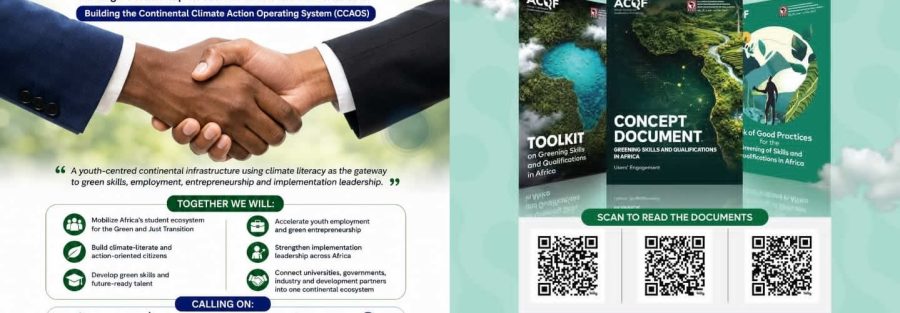
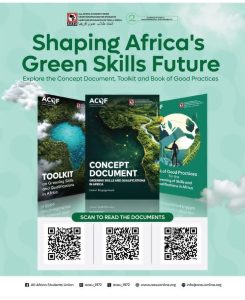 The outcomes of ACQF Phase II have been published, and WAGEDI’s Carbon Literacy Project work is included among the good practices featured — resources that will now inform policymakers, universities, TVET institutions, and youth organisations working on green skills continent-wide:
– **[ACQF–AASU Toolkit on Greening Skills and Qualifications in Africa](https://acqf.africa/resources/research/green-skills/acqf-aasu-toolkit-on-greening-skills-and-qualifications-in-africa)**
– **[ACQF Case Book on Green Skills & Qualifications — Good Practices](https://acqf.africa/resources/research/green-skills/acqf-case-book-on-green-skills-qualifications-good-practices)**
– **[Greening Skills and Qualifications in Africa — Users’ Engagement](https://acqf.africa/resources/research/green-skills/acqf-greening-skills-and-qualifications-in-africa-users-engagement)**
For WAGEDI, this is continental credibility — and credibility is what opens the door to real collaboration.
## From Dialogue to Partnership
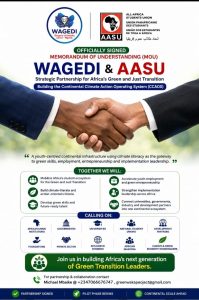
Our engagement with AASU didn’t end with ACQF. It was the beginning. After months of continued conversation, *WAGEDI and the All-Africa Students Union have now signed an official Memorandum of Understanding* — the institutional foundation for jointly building a continental initiative to mobilise Africa’s student ecosystem around climate action, green skills, and youth leadership.
## Carbon Literacy Is the Entry Point, Not the Destination
If there’s one thing this journey has made clear, it’s this: carbon literacy isn’t where the work ends. It’s where it starts. The vision now taking shape with AASU builds on that foundation as the first step in a longer arc — *Climate Literacy → Climate Action → Green Skills → Green Jobs & Enterprise → Leadership for Africa’s Green and Just Transition.* Awareness alone doesn’t change a continent. Pathways that connect learning to action, skills, employment, and leadership do.
## What This Means for Partners
We’re inviting ministries, universities, national student unions, development partners, the private sector, and African diaspora organisations to explore collaboration with WAGEDI on climate literacy, green skills, and youth-led implementation across Africa. If this ecosystem is where you already work, we’d like to talk.
Contact
Michael Mbaike
greenwakaproject@gmail com
—
With thanks to the African Continental Qualifications Framework, the All-Africa Students Union, the Carbon Literacy Project, our Executive Director Professor Magnus, and every partner making this work possible.